
Daddy Dearest
"Do you have a kiss for Daddy?"

Whether you love or loathe the word, “daddy” has taken on a life of it’s own in the current cultural zeitgeist. You can’t open up a single Tiktok comment section on a video of an attractive, confident guy without some jokey riff on him being a daddy being espoused in the responses (regardless of age! Not to show my own, but that 22 year old man is not your daddy!). It’s been this way for several years and holding steady, with a 2017 Nylon article saying “The popularity of the term “daddy” has skyrocketed over the past couple of years. A male-identifying public figure can’t tweet or post anything without receiving replies like “daddy,” “hi daddy,” or “pls see me daddy.” Even the Pope has had Twitter fans call him “daddy.”” Admittedly, that last one seems most apt, given that “Pope” is derived from the Ancient Greek “páppas” which means “father” and in Spanish he’s called Papa, which again literally translates to “father,” but still.

A 2019 article from Inside Hook1 tracks the popularity of the term, positing the current US millennial/Gen Z fascination with the word may stem partially from the pouty, swaying lyricism of Lana Del Rey crooning about her tumultuous, scandalous, sultry relationships with older men. However, let’s not scapegoat Miss Del Rey entirely (and I would be remiss as a fan of hers not to point out that many of her songs do show the unhappy side of these fantasy relationships. It’s not all “Winin’ and dinin’, drinkin’ and drivin’ / Excessive buyin’” but also “The other woman will always cry herself to sleep / The other woman will never have his love to keep” and sometimes “His money on the side, money on the side / Makes me a sad, sad girl”) as the first recorded use of daddy not as a term of endearment for one’s father was in 1681, with prostitutes using it to refer to pimps and older Johns. This trend of sexual nuance for the word continues into the 1920s and 1930s, where it become a common truncation of “sugar daddy,” this of course being a wealthy older man who provides money, experiences, and material goods to a younger woman (the “sugar baby”) given that she provides “sugar” in return.
This culminates quite nicely in the brief but scandalous and captivating whirlwind “romance” of Daddy and Peaches Browning, a real estate developer from New York City who had a penchant for very young girls and the 15 year old girl he married when he was 51. They met and were wed in 1926 and thanks to the heavy media scrutiny of their relationship, their lavish lifestyle documented in the tabloids, and the hasty marriage to avoid censure from the New York Society for the Prevention of Cruelty to Children, both their names become fashionable (or infamous) nicknames in modern slang. Daddy’s nickname, as he was born Edward West Browning, came about from an interview he gave after his first marriage ended in divorce and the judge presiding over the custody battle of their two daughters elected to give each parent one of the children, Parent Trap style2. He mentioned to a reporter that he enjoyed giving people he liked pet names. His daughter’s nickname was Sunshine and she called him Daddy. Once he reentered the media landscape with his relationship with Peaches, which was his nickname for her as she was born Frances Belle Heenan, his new moniker was cemented.


In the article “What Did Peaches Say?” published in American Speech (Feb 1962), Thomas J. Creswell argues that since most other dictionary entries only defined “daddy” as being a colloquial term of endearment for a father until the Dictionary of American Slang’s 1960 definition of “a male lover, especially one that supports his paramour,” “daddy” as a slang term to refer a male lover, “may be a ‘pure’ Amercanism.” He bolsters his argument by pointing out that not only did Daddy Browning’s relationship with Peaches create this connection in the American cultural psyche, there had been in preceding years a trend to refer to male lovers with the term “daddy” or “poppa” in popular Black American and blues songs. Creswell draws a connection between one popular song called “I Wonder Where My Sweet Poppa’s Gone,” in which “poppa” refers to a male lover, and a reporter for the Chicago Tribune calling Daddy Browning a “fairy god-papa to youthful flappers,” suggesting the reporter was already subconsciously aware “of the racy overtones which had already become associated, as in the case of daddy, with this once thoroughly respectable diminutive.”
In all of these instances, the daddy is an older man and decidedly not blood related. Naturally, glamorization and fantasy have their effect, and in modern mythology the archetypal Daddy is an older, confident, successful, suave, charming gentleman, children not necessarily required.


Speaking of children, there has been some pushback in recent times, with some people upset at the perversion of a word that many do use earnestly to refer to their fathers. After all, the OED has listed both “dad” and “daddy” as terms of endearment for a father since the 1500s. Anecdotally, I feel that more women and girls refer to their fathers as “daddy” than boys would, and that’s it definitely more of a Southern and Eastern US culture marker to call older men as “daddy” or even have that be part of their common nickname with no sexual implication at all. Think of Big Daddy Pollitt from Tennessee Williams’ play Cat on a Hot Tin Roof, Eli “Big Daddy” La Bouff from Disney’s The Princess and the Frog, and Daddy Warbucks from the Little Orphan Annie comic strip. All three are extremely successful businessmen with power, respect, and influence in their respective communities and none of their nicknames are used with sexual connotations.
With all this in mind, let’s take a look at two perfumes who have that decisive and tumultuous moniker for their name and see what they say about masculinity, father figures, and the sexy Silver Fox.
Perdrisât - Daddy
Concentration: eau de parfum
Perfumer: Callum Rory Mitchell
“Banana smoothies and Kretek cigarettes” states the simple copy for Daddy on Perdrisât’s website and that is very much what it is. Kretek, also known generally as clove cigarettes, are an Indonesian variety of cigarettes made with cloves and other spices that are rolled alongside the tobacco. Kretek itself is an onomatopoetic word meant to mimic the crackling of the clove when burned.
The fragrance starts with the bite of cloves mixed together with nose tingle of tobacco, peppery in your nostril like you’re about to sneeze. There’s a thin tremulous note of stale smoke in the background of it, the remnants buried inside a smoker’s favorite t-shirt, nearly lost to the air on every sniff. Underneath it all, never leaving the warmth of your skin, sits a gentle banana note. It’s so light and thin it’s forgivable that you may not recognize it as banana, as there are quite a few accords that lean towards the plasticky Laffy Taffy and some that veer into overripe mash. This however is the gentle ambient smell of banana that’s light butter yellow and unblemished, just plucked off the tree. There’s a creaminess to it, a frozen banana froth in the summer or the smell of a fancy suncream, sitting in yummy contrast to the sharp tobacco and clove above it. These two distinct parts of the scent never mix, the cloves and tobacco float in the air and the soft banana sits below. This is a linear scent, the only change is the tobacco and cloves thinning out as time passes, eventually wafting away entirely. I went to sleep and woke up the next morning to find the banana lingering where I’d sprayed it in my hair.
It reminds me very much of standing near someone who smokes and smelling the cigarettes in their pocket and the smoke on their clothes and then the soft sweet smell of them and their SPF and leftover cologne underneath when you go in for a hug. Whether the man in this bottle of Daddy is supposed to be your father or a man you want to be your daddy, I’m uncertain, and we’re given no hint from the brand to unravel our interpretation, but it’s certainly someone you know well and enjoy being around. Someone you like smelling tobacco smoke on and hope to smell in your hair long after they’ve gone.

Universal Flowering - Daddy
Concentration: eau de parfum
Perfumer: Courtney Rafuse
This is spicy, herbaceous, and cold. It’s made up of several powerful aromatics with barely anything to temper. Hinoki (Japanese cypress), oakmoss, vetiver, and guaiacwood are the pillars here. As soon as it’s applied it’s this minty herbal cold spicy fragrance, like if Vicks Vaporub and the remnants of incense from church had a chilly, cypress needle offspring. It somehow both a modernization of the classic barbershop aftershave and also decidedly very vintage smelling. I feel somehow that this smells exactly like whatever Kevin splashed on his face in Home Alone and the same crazy menthol burn that you get in really combative mouthwashes is what made him scream, and now you can apply it to your wrists. This fragrance is perfect if you wish Stora Skuggan’s Pine was somehow even more aggressive. Really takes you by the nose and leads you around. Not a ton of complexity in the fragrance, what you smell at the beginning is what you smell at the end, but I don’t think that’s a detraction.
Universal Flowering provided this wonderful, evocative bit of prose to accompany this fragrance, and it provides a little context to how to interpret this fragrance’s title:
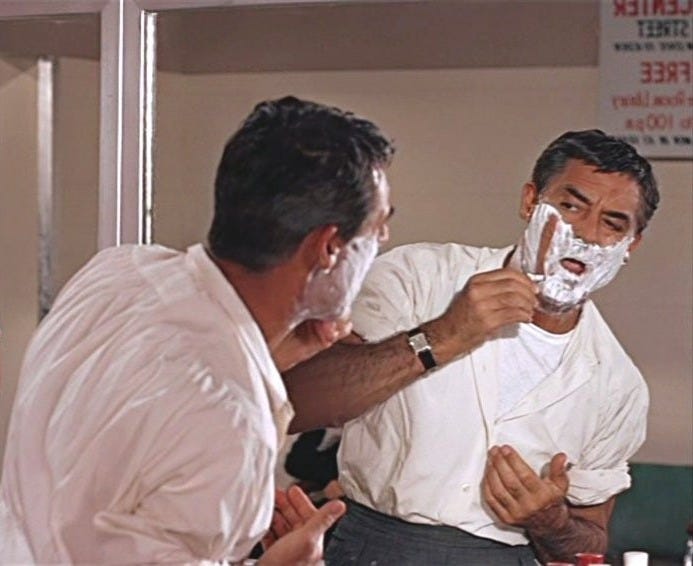
you stand at the mirror in the picture I have of you. it’s fogged but for one clear streak from your long strong fingers. I’m perched tubside, out of frame watching you lather your badger brush. I want you to put your hand on my cheek, tip my chin back, and scrape the steel across my skin. the white foam falls into the sink, still white. I want you to render me gentle and smooth my reflection soft with steam, and you’re soft too. I want you to find my eyes In every morning mirror
Given that this is a take on a classic barbershop aromatic aftershave splash kind of scent, it’s clear it’s meant to conjure the image of a vintage man, one who still uses a brush to apply his shaving cream before reaching for his beautiful steel safety razor. I can easily see this being a man who fits the archetype of Daddy, older and old school, maybe even uses a tie pin, his lover’s imagination torn between the thrill of danger from the razor he wields and the gentle touch he soothes with, metaphors no doubt for other treatments at his hand, “every morning mirror” being a hope for a continued relationship. However, it could also be a reminiscence of someone’s father, the picture in this case being literal, a memory of being a child and watching your father’s ritualistic preparation for the day, him being “soft” and younger in that hazy fog of recollection, “every morning mirror” here is an adult’s longing for more time with a parent they miss.
Regardless of how you choose to read the title, the smell no doubt conjures up a man. That familiar smell of aftershave and maybe deodorant, the sharpness is your nostrils signifying a gentleman who’s grown up, assured, knows himself, and you know him too. To wear this fragrance is to carry him with you, however you love him.
A Father’s Love
Whether you have a dad or a daddy in your life, both these fragrances are worth a smell for their intriguing interpretations of the word “daddy” and their smell associations. I personally find both fragrances to be quite gender neutral and fantastic to wear. Try a spray on and see what you smell in the names.
And here’s one of my favorite clips from Ferris Beuller’s Day Off, although it cuts off before Principal Rooney’s remark of “so that’s how it is in their family.”
I also can’t help but chuckle at the prescience of a 2019 article calling the state of the world “pre-apocalyptic.” Just you wait, buddy, it’s about to get worse.
Putting to rest the age old question of “what sane judge would settle a custody dispute this way?”